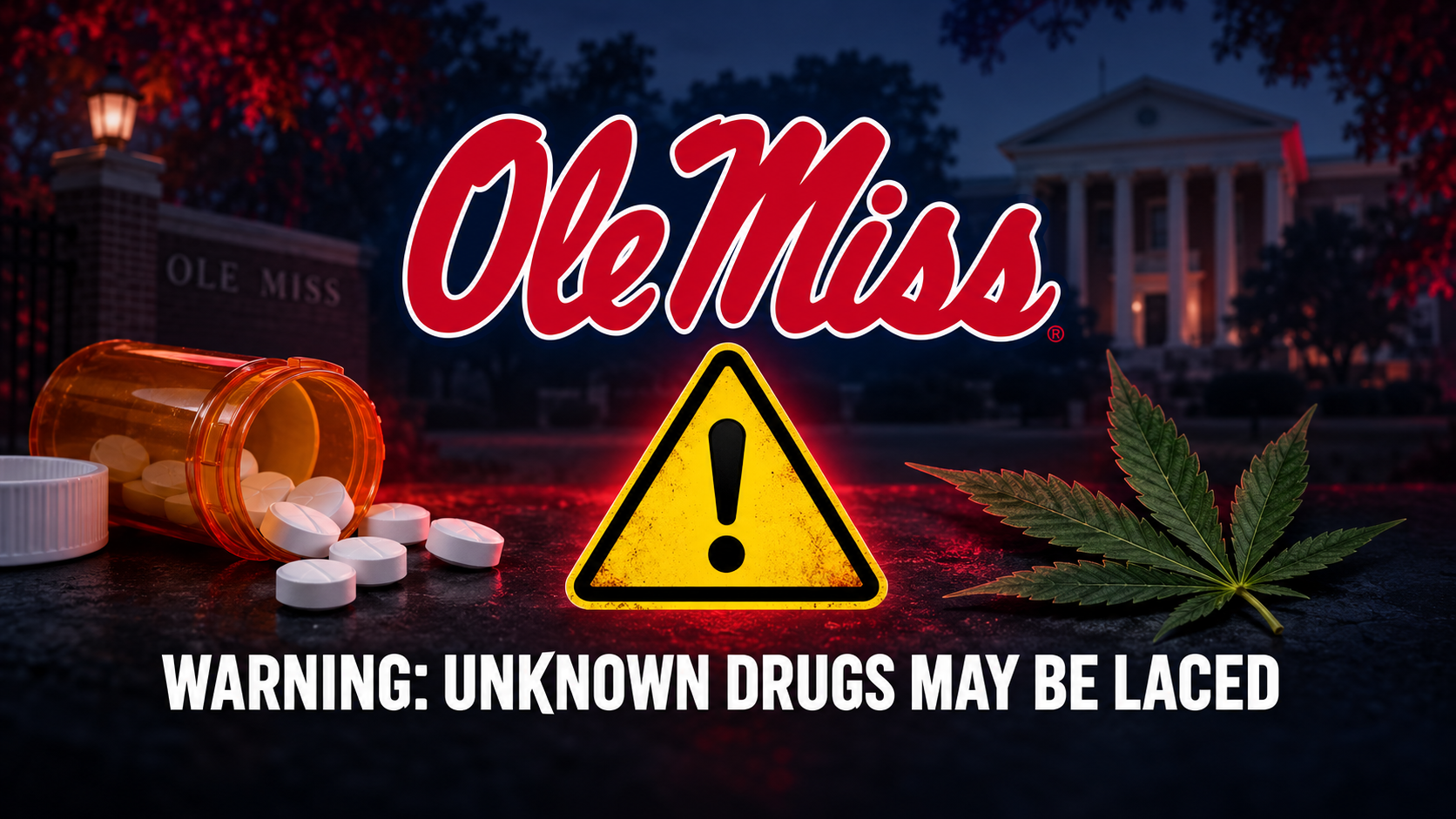
Ole Miss Student Deaths Spark Laced-Drug Fears: What College Students Need to Know
The University of Mississippi community is mourning after officials confirmed the deaths of two students. As news spread across Ole Miss and the surrounding Oxford community, social media posts began claiming that several students had died from overdoses involving laced drugs.
At this time, those broader claims have not been verified.
The Lafayette County coroner confirmed two student deaths on September 22, 2026, but the students’ identities and official causes of death had not been released. Local reporting said emergency responders were sent to Stewart Hall shortly after 1:30 p.m. on September 21 for a possible overdose involving an unresponsive person while CPR was underway.
Another circulating post claimed that a student was found at a home on Van Buren Avenue with pills nearby. It also alleged that five fraternity members died, a large drug-trafficking operation entered Oxford from Louisiana, and all drugs in the area should be presumed laced. None of those broader allegations had been confirmed by university officials or law enforcement when this article was written.
Ole Miss released a statement acknowledging the loss of two students while warning that considerable unverified information was circulating online. The university said police were not aware of additional recent student deaths and urged the community not to speculate while the investigations continued.
It is important to respect that request. Two families are grieving, and toxicology examinations can take time. A possible overdose dispatch does not establish an official cause of death, and an online post is not proof of a trafficking operation or widespread contaminated drug batch.
However, the rumors reflect a real and urgent fear on college campuses: illicit pills and powders can contain fentanyl or other unexpected substances. Students should understand the danger even before investigators determine what happened at Ole Miss.
What Has Been Confirmed at Ole Miss?
The reliable facts remain limited:
- Two University of Mississippi students have died.
- The Lafayette County coroner confirmed both deaths.
- One emergency dispatch reportedly described a possible overdose at Stewart Hall.
- The causes and circumstances of the two deaths remain under investigation.
- University police are communicating with local authorities.
- Ole Miss said police were not aware of additional recent student deaths.
- The university asked the public not to spread unconfirmed claims.
There has been no official confirmation that five students died, that the students were fraternity members, that a Louisiana trafficking organization supplied drugs in Oxford, or that every drug in the community was contaminated.
Those claims should not be repeated as established facts. Sharing an inaccurate number of deaths can cause panic, intensify the suffering of families, and interfere with accurate public-safety communication.
Students should follow updates from Ole Miss, the University Police Department, the Oxford Police Department, the Lafayette County coroner, and established local news organizations.
What Does It Mean When Drugs Are “Laced”?
Fentanyl is one of the greatest concerns. It is a powerful synthetic opioid used medically for severe pain but also manufactured and distributed illegally. Illicit fentanyl may be mixed into heroin, cocaine, methamphetamine, or pressed into counterfeit pills.
Counterfeit pills are designed to resemble legitimate prescription medications. The Drug Enforcement Administration warns that fake pills may look like oxycodone, hydrocodone, Xanax, or Adderall while actually containing fentanyl, methamphetamine, or other substances.
A student may believe that a pill came from a pharmacy because it has familiar markings, color, or shape. Visual inspection cannot reliably determine whether a pill is legitimate. Unless medication was prescribed to the individual and dispensed by a licensed pharmacy, its contents and strength are unknown.
Why Fentanyl Is So Dangerous
Fentanyl can slow or stop breathing. The amount present in an illicit product may be unevenly distributed, meaning two pills from the same supply can contain very different amounts.
People who do not regularly use opioids may have little or no tolerance. Someone intending to take a stimulant, anti-anxiety medication, or pain pill may unknowingly consume an opioid and lose consciousness within minutes.
The Centers for Disease Control and Prevention explains that illicit fentanyl is increasingly pressed into pills that resemble medications such as oxycodone or alprazolam. It can also appear in cocaine, methamphetamine, heroin, and other substances.
The risk increases when people combine opioids with alcohol, benzodiazepines, sedatives, or other drugs that suppress breathing. Polysubstance use can make an overdose harder to predict and treat.
Signs of an Opioid Overdose
Warning signs include:
- Inability to wake the person
- Slow, shallow, irregular, or stopped breathing
- Pinpoint pupils
- Blue, gray, or pale lips and fingernails
- Limpness
- Vomiting
- Cold or clammy skin
- Choking, snoring, or gurgling sounds
- A slow or absent pulse
Call 911 immediately if an overdose is suspected. Tell the dispatcher that the person is unresponsive and may have taken an opioid. Follow instructions, provide rescue breathing or CPR if trained, and administer naloxone when available.
Do not leave the person alone. If one naloxone dose does not produce a response, additional doses may be needed according to product directions and emergency instructions.
How Naloxone Saves Lives
Naloxone, commonly known by the brand name Narcan, temporarily reverses the effects of an opioid overdose by restoring breathing. The Food and Drug Administration has approved naloxone products for over-the-counter use, allowing people to obtain them without a prescription.
Naloxone will not harm someone who is experiencing a different medical emergency. If the situation might involve an opioid, administering it is generally safer than waiting.
Naloxone’s effect can wear off before the opioid leaves the body. A person may stop breathing again after initially waking. Always call 911, even when naloxone appears to work.
College students should learn where naloxone is kept on campus and in the surrounding community. Residence halls, fraternity and sorority houses, campus health centers, bars, event spaces, and apartment buildings can all benefit from accessible naloxone and trained responders.
Can Fentanyl Test Strips Detect Laced Drugs?
Fentanyl test strips can identify the presence of fentanyl in many pills, powders, and injectable drugs. They can provide potentially life-saving information, but they have limitations.
A negative result does not guarantee that a drug is safe. The strip may not detect every fentanyl-related substance, and contamination may not be evenly distributed throughout a pill or powder. Test strips also do not reveal the amount of fentanyl or identify every other dangerous substance.
The safest choice is not to use medication or drugs obtained outside a licensed pharmacy. When someone does use, risk-reduction steps include testing the substance, carrying naloxone, avoiding combinations, never using alone, and ensuring another person can call for help.
These precautions reduce risk but cannot make illicit drugs safe.
College Parties and Counterfeit Pills
Students may encounter pills through friends, roommates, social-media contacts, parties, or people who claim to have legitimate prescriptions. Familiarity does not establish safety. A friend may not know that a pill is counterfeit.
Some students use stimulants they believe are Adderall to study, sedatives they believe are Xanax to manage anxiety, or pills they believe are prescription opioids after an injury. Counterfeit versions can contain unexpected substances and unpredictable doses.
Students should remember:
- Never take medication prescribed to another person.
- Do not trust a pill because it looks authentic.
- Do not buy medications through social media or messaging apps.
- Avoid mixing drugs with alcohol.
- Carry naloxone and know how to use it.
- Call 911 immediately when someone becomes unresponsive.
Fear of disciplinary consequences should never prevent an emergency call. Ole Miss tells students that police care about what happened to them even if underage drinking or drug use was involved. State and campus Good Samaritan or medical-amnesty protections may also apply, depending on the circumstances.
Why Rumors Can Make an Emergency Worse
Social media spreads warnings rapidly, which can help alert a community. It can also turn incomplete information into apparent fact.
In the Ole Miss situation, posts combined a confirmed tragedy with unverified claims about the number of deaths, fraternity involvement, drug trafficking, and laced substances. A dramatic claim may be reshared thousands of times before law enforcement can complete interviews, laboratory testing, or autopsies.
Students can communicate responsibly by:
- Sharing official safety alerts rather than screenshots without sources
- Clearly labeling unconfirmed information
- Avoiding the names of deceased students until families or officials identify them
- Not assuming that two separate deaths have the same cause
- Correcting inaccurate information when officials release updates
- Focusing on practical safety guidance rather than blame
Responsible communication does not mean ignoring danger. It means warning people without presenting rumors as verified evidence.
How Parents Can Talk to College Students
Parents should discuss counterfeit pills directly without turning the conversation into an interrogation. Ask what students have heard, whether naloxone is available, and how their friends would respond to an overdose.
Make it clear that your child can call you for help without first having to defend every decision. Fear of punishment can cause students to hide dangerous situations.
Useful questions include:
- Do you know where to get naloxone?
- Have you learned how to recognize an overdose?
- Does your school have a medical-amnesty policy?
- Would you call 911 if a friend became unresponsive?
- Do you know that counterfeit pills can resemble Adderall or Xanax?
- Who could you contact if substance use began feeling out of control?
One honest conversation can be more effective than a lecture based only on fear.
When Experimentation Becomes a Substance Use Disorder
Not every person who experiments with a substance develops an addiction, but any use of an unknown pill can result in poisoning or overdose. Repeated use creates additional risks.
Warning signs of a possible substance use disorder include:
- Strong cravings
- Using more frequently or in larger amounts
- Being unable to cut down
- Hiding or lying about use
- Missing classes or work
- Declining academic performance
- Withdrawing from friends and activities
- Continuing despite health or relationship consequences
- Developing tolerance or withdrawal symptoms
- Using alone or in dangerous situations
College students may use substances to cope with academic pressure, anxiety, depression, trauma, loneliness, or social expectations. Effective treatment should address both substance use and the reasons behind it.
Finding Help After an Overdose or Drug Scare
An overdose should be treated as more than a one-time emergency. After stabilization, the individual may need medical care, an addiction assessment, mental health support, medication for opioid use disorder, counseling, or a higher level of treatment.
Friends who witness an overdose may also experience guilt, anxiety, nightmares, or trauma. Campus counseling and community mental health resources can help them process what happened.
The deaths at Ole Miss remain under investigation. Until officials release their findings, no one should claim to know exactly what caused them. The confirmed loss of two students is tragic enough without exaggeration.
Find Addiction Treatment in Georgia
The fears circulating around Ole Miss highlight a reality that extends far beyond one campus: today’s illicit drug supply is unpredictable, and counterfeit pills can expose students to fentanyl without their knowledge.
Georgia Addiction Treatment Center provides compassionate care for people struggling with substance use and co-occurring mental health conditions. Treatment can help individuals understand their patterns, manage cravings, address underlying emotional concerns, and develop a plan for long-term recovery.
If substance use is affecting you or someone you love, call Georgia Addiction Treatment Center at 855-952-3546. A confidential conversation can help you explore available treatment options and determine an appropriate next step.
Call 911 immediately if someone is unresponsive, not breathing normally, or experiencing a suspected overdose. Administer naloxone if available and remain with the person until help arrives.